
Visiting Malta!
Visiting Malta intro…
Table of Contents
Flights
Wondering “which airport in Malta should i fly to?”
Good News, Malta is tiny! There is only 1 airport on the island!
Flights typically cost between £150-250/pp including 10kg cabin bag, depending on the time and day of the week.
We have found Thursdays to be a good day to fly, price-wise.
When looking on price comparison sites (like skyscanner.net), keep in mind that British Airways & Air Malta are the only airlines that include a 10kg cabin bag within the flight price. All the other airlines will charge to add suitcases.
Accommodation
Next question… “Where are you staying? / Where is the venue?”
More good news, Malta is still tiny! Driving from the north tip to the south tip takes just over an hour and the venue is pretty much in the middle. You really can’t be too far away (even if you tried).
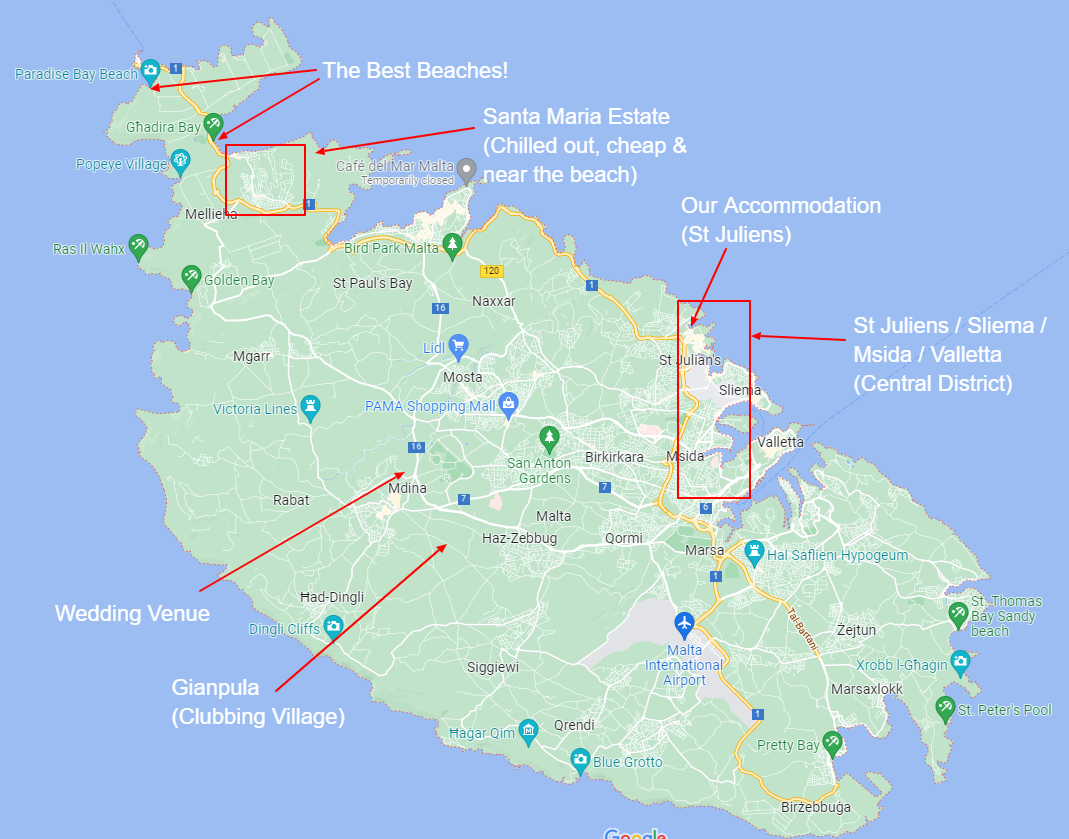
Transfers will be provided from the central district (St Juliens, Sliema, Msida & Valetta) and Mellieha area to the wedding venue.
We will likely head to ‘Gianpula’ (the best clubbing village on the island) after the wedding. You are free to join us, otherwise, transport home is easily bookable when you are ready to leave via the local taxi services.
St Julians (where we are staying)
Tourist party zone. Its nothing like Ibiza, but still expect it to be louder, wilder and alive later than other areas of the island. Please check accommodation reviews for how noisy your hotel’s area is as its not unheard of for hotels to have rooms directly above clubs and for ‘sea view’ rooms to face the busy high street. (£££)
Sliema
The retail/tourist hot spot full of restaurants, gelato parlours, etc. A solid choice if you want to be in the heart of the action without the nightlife that St Julians attracts. (££)
Valetta
The capital of Malta, tons of heritage and surely on your list of ‘places to visit’ (£££)
Mellieha
The ONLY place to be if you are looking for sandy beaches, warm waist-high sea & fish nibbling your toes. Typically much cheaper with a ‘chilled out’ vibe, the only downside being the 30min bus ride to the central district on bus route 222 / X1. (£)
Mdina (the silent city)
Our wedding venue is just outside Mdina’s city walls at a place called ‘The Olive Gardens’. Mdina is a beautiful picturesque city, with no roads or cars and stunning stone architecture.
Bugibba
A tourist hotspot on the coast, nearly mid-way between Valletta/Sliema and Mellieha (£)
One week’s accommodation for a couple ranges from £400 – £2,000 depending on location, level of accommodation & what food/drink is included.
If you have any questions or concerns about where to book, feel free to contact Bailey for some guidance. (+44 7913 710 834)

Get Packing
The good thing about a September wedding in Malta is that you can pack light. The weather should be beautiful, not too hot, not too cold! If you’re taking the opportunity to work in a little holiday too, here’s a few things you might need:
Swimming Costume
Beach Towel
Flip Flops
Sunglasses
Beach Bag
Sun Hat
Sun Cream
Mosquito Repellent
Thin Scarf*
*useful for extra sun protection and covering up if you plan to visit some of Malta’s beautiful churches (zero tolerance for exposed chests and upper arms).
If you don’t fancy living in your bikini all week, the rest of your clothes won’t take up much space either. You’ll be wearing half the material you’re used to in the UK (I’ll let you decide which half 😉 ) – think shorts and t-shirts, or dresses and sandals.
Your heaviest items are likely to be your SPF 30, toiletries & mosquito repellents!
Malta's Weather in September
Sun & Heat
A Mediterranean archipelago of three islands that sits between Sicily and North Africa promises some of Europe’s best weather. Summers are long, hot, and dry, meaning September’s a great time to visit!
Malta’s nice and hot in September, and has an average high temperature of 28ºC. As mentioned above you’ll need your swimwear and beach gear for the day and only some light clothes for the evenings as temperatures only drop to 20ºC. It may be worth considering getting a room with air conditioning.
The sea’s lovely and warm and has an average temperature of 26ºC, while humidity’s moderate and ranges from 50% to just over 90%.
Daylight
Malta gets loads of sun in September and has an average of 12 hours of daylight with nine hours of sunshine each day. The sun sets at 7.30pm at the start of September and gradually gets earlier as the month goes on (this should happen whilst we are eating, ready for our night time dancing).
Getting Around Malta
Ride the Buses
Malta is compact, and bus service operated by Malta Public Transport is a convenient way to explore, routes begin from the Bus Station in the capital city of Valletta.
The frequency of buses ranges from every ten minutes to hourly on less busy routes. However, the lack of punctuality can be a challenge, and afternoon and evening buses often run late!! Buses are best used for focused day trips to places such as Mdina and Marsaxlokk. Because most routes originate in the central hub of Valletta, using buses to visit several destinations in a single day can be problematic.
Check Malta Public Transport’s online journey planner or the Tallinja App for bus schedules and timings.
Single tickets a two-hour transfer window cost €2 and can be bought on board buses
12 Journey Card for €15 which can be used concurrently by couples or families
Explore Card cost €21 and offer unlimited bus travel for seven days
Hop-on Hop-off Bus Tours
Bus tours are great ways to travel across Malta whilst seeing the beautiful surroundings. The hop-on-hop-off takes travellers to 32 fabulous places in the combined North and South tour, on-board audio commentary available in several languages and free headphones are normally included.
https://www.visitmalta.com/en/a/tour-buses/
Car Hire
Many remote beaches and smaller towns and villages on Malta are not serviced by bus, so having your own vehicle is a good option if you are looking to explore during your visit. Note however that road traffic in Malta is very busy, especially in the built-up area around Valletta, Sliema and St Julians, and parking can be difficult to find.
Driving and looking for somewhere to park in the narrow heritage streets of Valletta is not recommended. Park up before exploring Valletta on foot; there’s a Park & Ride facility just south of Floriana, from where free shuttle buses run to Valletta’s City Gate.
Car rental rates in Malta are amongst the lowest in Europe, especially if you use locally owned companies such as Billy’s Car Hire, get googling there are many more operators in Malta. It will be best to select a compact car to negotiate roads that will definitely be more narrow than you’re used to!
Enjoy Walking
Malta is a wonderful destination to explore under your own steam, especially the heritage streets of Valletta, Mdina’s hilltop walled city. For longer walks, many trails follow the dramatic coastline of Malta.
Taxis
Taxis are useful for city exploring. Conventional taxis can be booked with eCabs, either online, by phone or on their app, while Malta’s leading rideshare operator, also accessible by an app, is Bolt, with good service in built-up areas.
Visiting the sister island of Gozo
Shuttling between the northern Maltese port of Ċirkewwa and Mġarr Harbour on Gozo, Gozo Channel’s vehicle and passenger ferry takes around 30 minutes to cross between the two islands. Services run every 45 minutes from 6am to 6pm, and approximately every hour through the night.
Basic foot passenger tickets cost €4.65 for a return trip
Car and driver ticket costs €15.70 plus additional passengers pay the regular passenger fee
Gozo Fast Ferry provides a convenient passenger-only ferry linking Mġarr Harbour on Gozo to Valletta. Journeys take 45 minutes. This service is a good option if you’re planning on picking up a rental car at Mġarr Harbour or exploring Gozo by bike, e-bike or scooter.
Standard tickets cost around €10-12 per person
Malta's Cuisine
A cultural mash up of Sicilian, British, Spanish and even French cuisine, a fusion of Mediterranean influences…the food in Malta will have you pining for more!
Here’s our Top 10 list of the most heavenly ‘must try’ Maltese dishes in order of gorgeousness!
Pastizzi (v)
Possibly the most popular Maltese snack, pastizzi is a savoury pastry filled with ricotta or mushy peas. You can find these moreish treats in bakeries across the island, you just can’t leave without tasting one! (Bailey’s favourite is the ‘pea’ filling)
Ħobż biż-żejt
This popular snack offers visitors a true taste of Malta in a single bite. Crusty Maltese bread is rubbed with juicy tomatoes and then layered with cheese, tuna, onion and generous lashings of olive oil.
We usually make this ourselves without the tuna (v).
Ħobż tal-Malti (v)
It should be a crime to visit Malta and not try the local sourdough bread. With a crusty exterior and an irresistibly soft inside, you’ll never feel the same way about bread again.
Timpana
Timpana is a baked macaroni pie, and it’s every bit as delicious as it sounds. Made with a variety of meats, vegetables, cheese, bolognaise sauce and short crust pastry, the dish is baked until it’s perfectly golden brown. Again you can find these moreish treats in bakeries across the island.
Kapunata (Ve)
The Maltese version of ratatouille, kapunata is a popular summer dish made from fresh tomatoes, capers, aubergines and green peppers.
Prickly pears (Ve)
Growing abundantly all over Malta, the prickly pear looks a cross between a cactus and a melon, and has flavours reminiscent of strawberries, watermelon and figs.
Ġbejniet (v)
The local cheese, made from goat’s milk, is a must for any cheese connoisseur and has the texture and milky flavour of mozzarella. You can try ġbejniet in many forms, from salt cured and sundried to crushed black pepper.
Lampuki Pie
Surrounded on all sides by the sea, the people of Malta make good use of the abundance of fish available. Lampuki is a common fish caught around the island that is cooked in a delicious fish pie, containing potatoes, spinach, capers mint and olive oil.
Zalzett Tal Malti
One for all the meat lovers out there, zalzett are salty, garlicky sausages with a distinctive coriander flavour. These sausages are hard to get hold of elsewhere, so enjoy your fill.
Stuffat tal-fenek
A traditional rabbit stew, stuffat tal-fenek is considered the national dish of Malta. This lovingly prepared dish is slow cooked to ensure the meat falls off the bone and blends with a rich tomato, red wine and garlic sauce.
Eating Out
Hopefully the list of food has wetted your appetite…
Here’s a link to a great website providing Top 50 Best Maltese Restaurants in 2022
Where To Stay in Malta
There are three main areas in Malta where tourists stay and several other minor ones some of which we have covered as well as the ‘big three’.
The big three most popular areas in which to stay in Malta while visiting are:
Sliema / St. Julian’s / Gzira
Bugibba / St. Paul’s Bay / Qawra
Valletta / Floriana
The good news is that all areas in Malta are safe for tourists, we are super friendly!!
Sliema
One of the best places to stay in Malta, Sliema is the commercial capital of Malta and a great place to do some shopping and is also home to some of the more exclusive and expensive hotels in Malta along with neighbouring St. Julian’s to the north.
Sliema is an excellent choice for a place to stay in Malta for those people who love a variety of fine and casual dining options, as it has a plethora of both.
From Sliema, visitors have an unimpeded view across the harbour to Valletta, whose stunning medieval walls and churches are all lit up every night.
St Julian´s
St. Julian’s is a where to stay in Malta for nightlife, it’s former colourful fishing village turned high-end tourist lodging town, making it a fun place to stay in Malta. The highest building here is known as the Beckham building, where David Beckham long owned the top floor penthouse.
Visitors here will find a decent sandy beach on the north end of town at St. George’s Bay, many mostly high-end four and five star hotels, a beautiful seafront promenade that extends down into Sliema and is the longest continuous stretching walking promenade in Europe!
Two picturesque bays make up the town of St. Julians’ which nestles in between and around them, and you can still see the colourful Maltese fishing vessels in both Balluta Bay and Spinola Bay as they ply their ancient fishermen’s trade.
For those who thirst for edgy nightlife, this is the place to be and where to stay in Malta. Neighbouring Paceville is the hands down, purpose built nightlife capital of the islands. There are bars and nightclubs here ranging from swanky and trendy to down right sleezy to suit all interests.
A high-end shopping mall and several shopping streets provide a more docile form of entertainment for those who like to call it a night earlier.
Valletta
Valletta is the best place to stay in Malta for sightseeing, this is the walled fortress city capital of Malta, dotted with over 28 historic churches, the Inns of the Knights of St. John, interesting national museums, and several impressive fortresses and palaces as well.
From the Upper Barrakka Gardens you can enjoy free million dollar views over Grand Harbour into the Three Cities and the imposing Fort St. Angelo, still commanding the harbour vantage points and still held by the Knights of St. John (and occupied by them on the top floor of the three story fort) to this day.
There are not so many hotel options within Valletta city limits itself, though a few four and five-star hotel choices do exist inside and immediately outside of the walled city. The one square mile charming city holds the distinction of being the smallest capital city in all of Europe for good reason, and it was honoured as the European Capital of Culture for 2018.
Ferries are available to take visitors across the Grand Harbour to the Three Cities’ Vittorioso and also across to Sliema the commercial and shopping centre of the island.
St. Pauls Bay, Bugibba and Qawra
St. Pauls Bay, Bugibba and Qawra is where to stay in Malta for families, the northern nightlife centre of Malta is based around the three towns on St. Paul’s Bay— Bugibba, St. Paul’s Bay, and Qawra.
A favourite settlement among expats as well as the local Maltese, this is a place where visitors are just as likely to rub shoulders with British party people and expats as they are with working Eastern European and Balkans residents. As far as accommodation goes, this area has long drawn in budget conscious travellers from Great Britain and Northern Europe especially.
Any remnants of a fishing industry are long gone here, as the area has enthusiastically given itself completely over to its calling as a full-scale tourist area and resort. There are a few high-end hotels here, but most establishments are definitely on the budget friendly side of the price range.
The area really caters to those looking for sun, sea, and overflowing alcohol in abundance in a relaxed, seaside, non-stop party-like atmosphere.
Mdina and Rabat
Mdina and Rabat the original capital of Malta, Mdina and Rabat were originally a single town, the original capital of Malta.
Vistas from the top of Mdina provide beautiful countryside and city-scape views of nearly half of Malta. The area is mostly populated by locals and feels extremely residential, though bus loads of tourists come in on day trips from the hotels and cruise ships everyday.
Hotels in either Mdina or Rabat are scarce, smaller and more personable, and higher-end. Only 300 people populate Mdina, and many of their families’ ancestors have been resident within the walls for hundreds if not thousands of years.
Nightlife here is non-existent other than some really fine and pricey restaurants, as every night the towns return to their original and more familiar sleepy roles of being traditional Maltese countryside residential communities.
Mellieha
Mellieha is where to stay in Malta for a beach vacation, the beach capital of Malta, Mellieha Bay is wall to wall full of hotels ranging from mid range to high-end in price, all sitting directly on the bay and beaches. The town itself sits up on a high plateau overlooking the beach far below.
Mellieha is a charming out of the way settlement with as many people living here as in the capital. It was honoured as a European Union Tourism Destination of Choice for 2014, and remains a solid draw for those visitors to Malta who do not want to be in one of the three main crowded tourist centre’s of the island.
With over a dozen nationally regarded restaurants and pubs, it offers a decent selection of dining establishments and a far tamer form of nightlife here than St. Julian’s and its wild neighbour Paceville.
The main draw here is the beach and walks around the fairly large and most scenic town in Malta.
Mellieha is only not a great choice for those who crave a thriving and wilder nightlife, as it is a sleepier town where the bus service shuts down around 9 pm each night.
Things To Do & See
Malta truly has something to offer for everyone, this one visit to Malta will not be enough!
There is much to offer it’s impossible to summarise here so we’ve added a link to the Visit Malta website where you can explore possibilities that suit your individual interests.
https://www.visitmalta.com/en/things-to-do-in-malta-and-gozo/
If you’re looking for a steer we’ve summarised some of our family favorites
Mosta Dome Church
One of the island’s most prominent and famous buildings, the majestic Mosta Dome looms high on the glorious Maltese skyline. Based on the Roman Pantheon, this neo-classical masterpiece was constructed around a 16th-Century church and took 28 years to build!
With its most notable feature being its awesome Rotunda Dome. Said to be the third-largest in the world, it stands a whopping 52 metres high with an outside diameter of 57 metres.
The church was nearly destroyed in 1942 when a 200kg bomb fell through the dome without exploding. Miraculously, none of the 300 people attending mass inside were hurt and the bomb was successfully detonated. As notable for its history as for its splendour, the marvellous Mosta Dome is certainly not to be missed!
Splash & Fun
One of Malta’s most popular family attractions, the delightful Splash and Fun Water Park is one of the most prominent features on the scenic coastal road of Baħar-ic-Cagħaq. Full of aquatic delights to suit all ages, a visit to this wonderful water world is guaranteed to go down swimmingly!
Popeye Village
Looking for an outing the whole family will enjoy? Say ‘aye aye’ to Popeye’s Village! Situated in Anchor Bay, Popeye’s Village looks the same as it did when the iconic film was shot there nearly 40 years ago. Apart from the fact that it’s now home to a spectacular fun park too!
Mdina, Our Old Capital – ‘The Silent City” & Fontanella Tea Garden
Close to our wedding location and behind its fortified walls, Mdina’s timeless beauty is mesmerising and should be on the ‘must do’ list. With narrow, cobbled streets Mdina will snatch you away from the present and transport you back in time.
Mdina is a fortified medieval town enclosed in bastions, located on a large hill in the centre of Malta. The town was the old capital of Malta, and with its narrow streets, few inhabitants and beautiful views over the island it is truly a magical town. Mdina is referred to as the “Silent City” by Maltese and visitors alike – no cars (except those of a limited number of residents) have permission to enter Mdina and the town provides a relaxing atmosphere.
Mdina has a small population of around 250 people who live at 0.9km2, within the city walls. In contrast, outside the city walls, the village of Rabat is just a step away, and has a population of over 11,000 people.
To take in the amazing views it offers and its wonderful cakes and coffee, we highly recommend while you are there you visit the famous tea shop Fontanella.
https://www.fontanellateagarden.com.mt/home
Maltese Language
Malta has two official languages, Maltese and English and both are spoken fluently by the vast majority of the population.
A considerable portion of the population prefer to speak English, or were raised as English-speaking primarily. Both English and Maltese are compulsory academic subjects in schools.
Although the vast majority of the population speak English, most prefer to speak Maltese with fellow countrymen. Even though English is an official language, the language of the people remains Maltese, which is very much part of the Maltese identity and important to most.
Spoken by half a million people in the whole world, Maltese sounds strange to visitors, some feel they should be able to understand it, but many cannot. This is mostly because three out of every ten words in Maltese are words from either English, French or Italian, while the rest have Semitic roots. Examples include common expressions like ‘thank you’ or grazzi (grazie in Italian), and greetings like ‘hello’, bonġu (bonjour in French) or bonswa (bonsoir, also French.